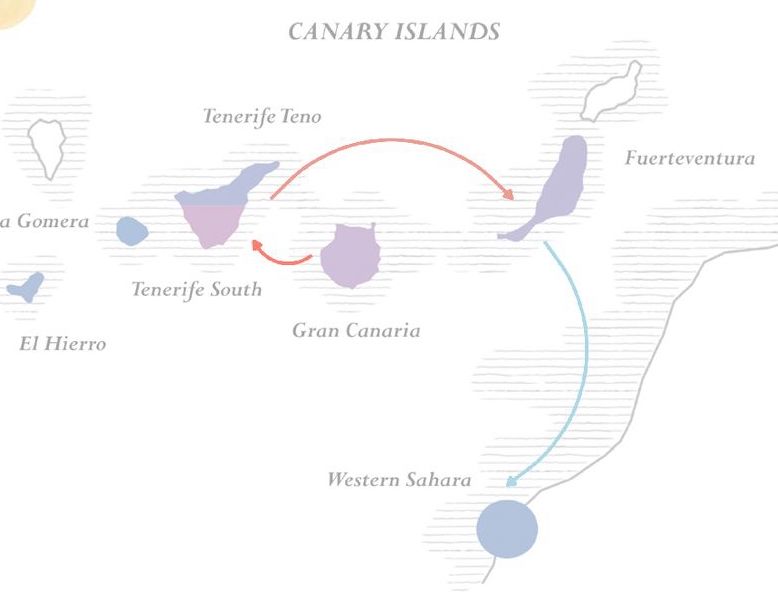
Our new research, “Structure knows best - predicting ecological interactions across space through pairwise integration of latent network patterns”, is now available on EcoEvoRxiv!
In this study, we introduce a spatially explicit network-based framework to predict missing species interactions while explicitly accounting for spatial variability in ecological communities. Applying the method to plant–pollinator networks across the Canary Islands, we show that latent network structure alone contains strong predictive power for identifying unobserved links. Predictive accuracy depended critically on spatial context, with performance highest when information was drawn from nearby, ecologically similar sites and declining with geographic and ecological distance. Our results highlight that incorporating spatial structure is essential for reliable link prediction and for uncovering the ecological processes shaping complex interaction networks.
Read the full paper here: EcoEvoRxiv